
NASER JAMAL AZAYANI
ناصـــر جمــــال الزيانــــي
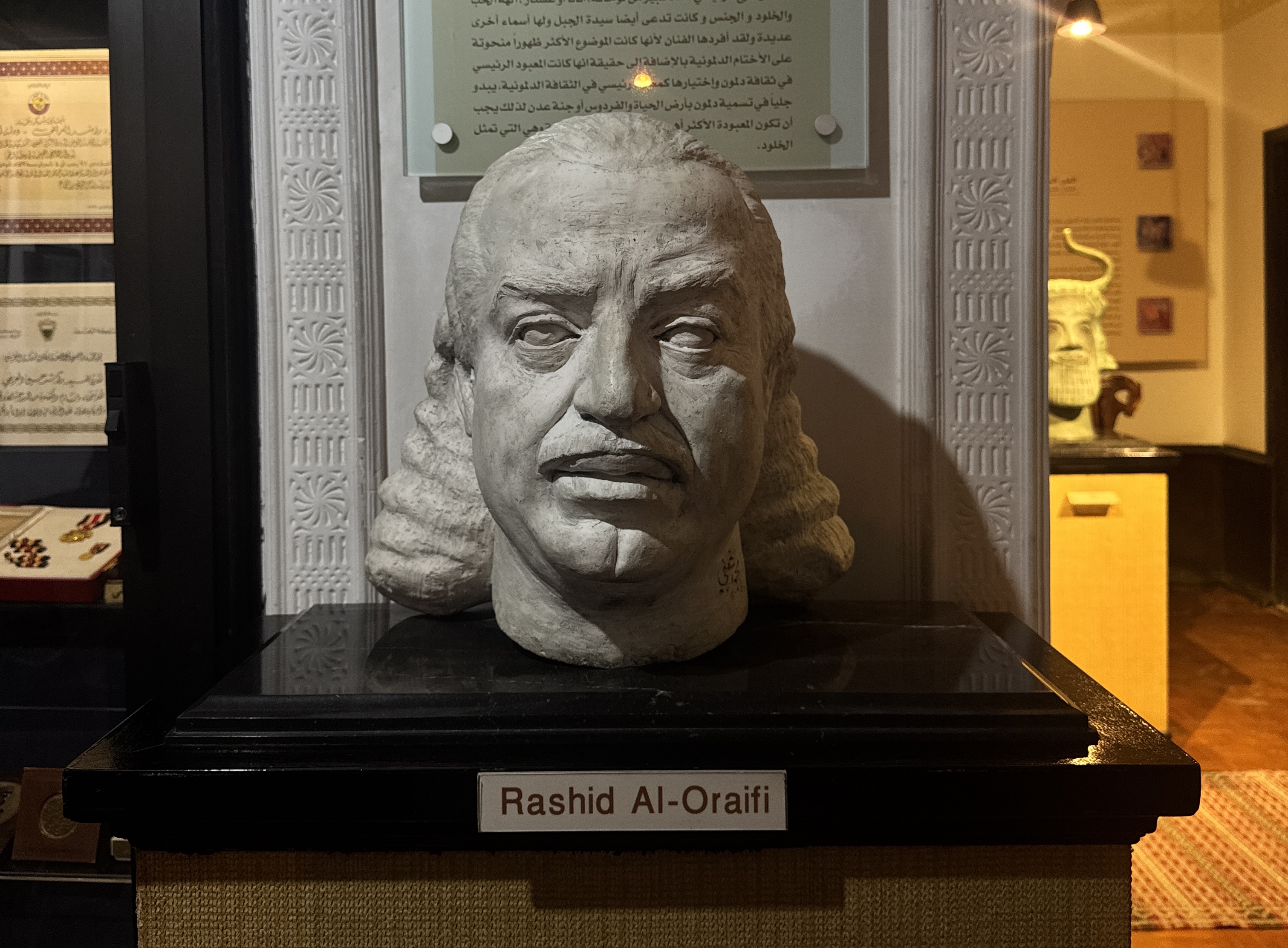
As an attempt to keep up with the art scene in Bahrain, I try as much as possible to attend any exhibition openings, or sometimes, towards the closing, if I am very busy. However, recently, Rashid AlOraifi’s Gallery in Muharraq reopened momentarily. I didn’t even have to press myself to attend it; I had to attend it, whether I am stretched so thin or not. To my surprise, when I went there, many of the people were extremely knowledgeable about the paintings, or each artwork and what it means or what Dilmunian symbol inspired it. Surprisingly, no one knew the story of why AlOraifi was obsessed with Dilmun, except for his relatives. In a discussion with them, here is the story:
Born in 1942, Rashid Al-Oraifi grew up during pivotal moments in Bahrain’s history, experiences that helped shape his identity and creative path. These moments were not necessarily positive; they might be considered extremely unkind, but they echoed the right amount of influence.
Excavations in Bahrain Fort began in 1954; during that time, an infamous archaeologist was leading the archaeological expedition. His name was Geoffrey Bibby, and he authored the book “Looking for Dilmun.” While this book is considered quite controversial, it tackled his journey that started in Bahrain, where he was digging for archaeological sites. During his excavation digs of Bahrain Fort, he found stamp seals originating from the Dilmun Civilisation.
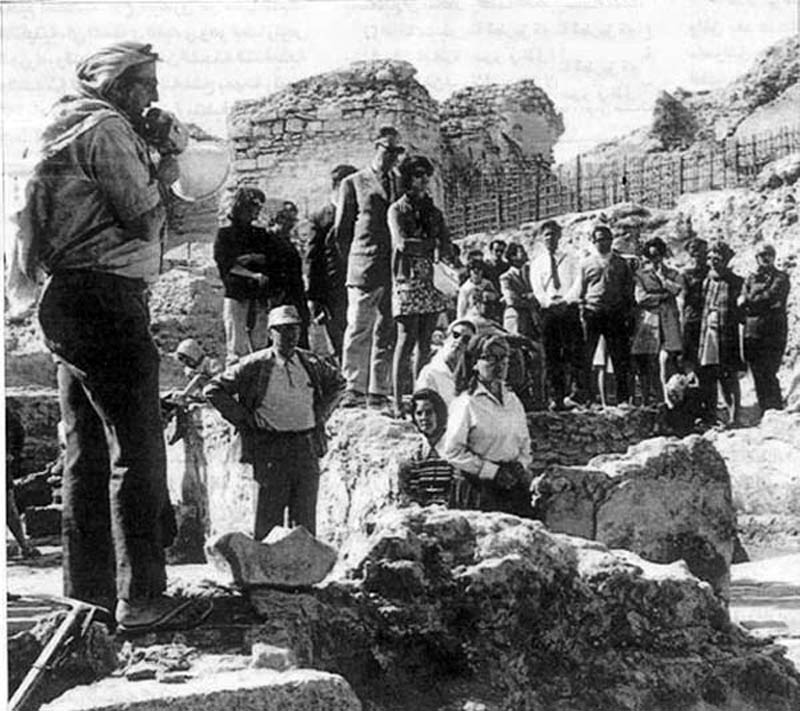
Laid on the ground, these stamps were marvels never seen by locals. I would imagine that people from all over Bahrain were there, witnessing this important historic event in Bahrain. However, what I am sure about is that there was a young person there who was extremely intrigued. This person was Rashid Al-Oraifi, one of the first artists in Bahrain. Tempted by the mystical presence of these artefacts, he attempts to reach out to them with his hands, to touch them, but once he was very close, a slap! Geoffrey Bibby slapped AlOraifi’s hand, stopping him from touching these artefacts, and leaving him in agony to explore these parts of any local’s DNA.
I would say the rest is history, but I am also intrigued to know more about that piece of history later on. The first time I heard this story was during a lecture given by Abdullah Almutairi, virtually during the AA Visiting School of Bahrain, and the second time was confirmed by AlOraifi’s relatives.
Rashid AlOraifi himself stated the following in a booklet called “The Dilmunian Style in Contemporary Art”, produced for Bahrain Assilah Arts & Culture Forum:
“The Dilmun Civilisation, which was placed in Bahrain, and dated between 3200 BCE and 540 BCE, left a humongous wealth of its indications, remains, mainly concentrated in the Dilmunian stamp seals, which are stamps engraved on stones that are shaped meticulously, and positioned on them these engravings, which are in the form of stamps used for various purposes. And these stamps were the “book” that preserved so many of Dilmun’s civilisation, culture and arts. Whether it was indirect or intended, it was the gate that many of the scholars entered through the worlds, which many did not know about.”
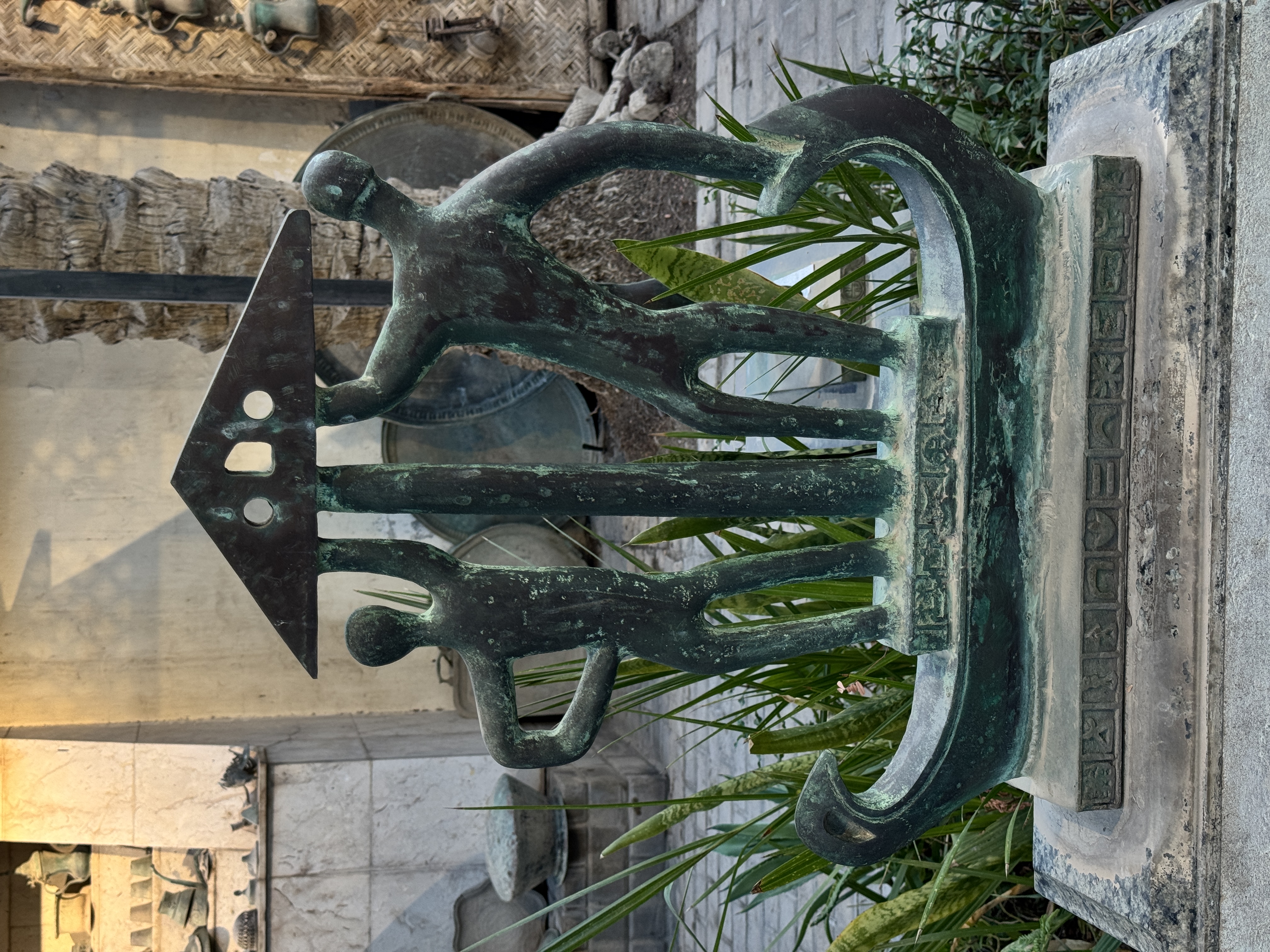
Beautifully enough, a plethora of paintings, interpretations, and shapes of art were produced from a singular source of inspiration, which was dubbed the “Dilmun School”, carries the legacy of Rashid AlOraifi, and transcends it to a different form of “artefact”.
During the 1970s and 1980s, many governmental executives were commissioning Bahraini artists to contribute to the public realm of Bahrain and design civic monuments as public statues. One of these artists was Rashid Al-Oraifi, as he was commissioned to design five monuments, if I remember correctly. In this piece, I will discuss two of them.

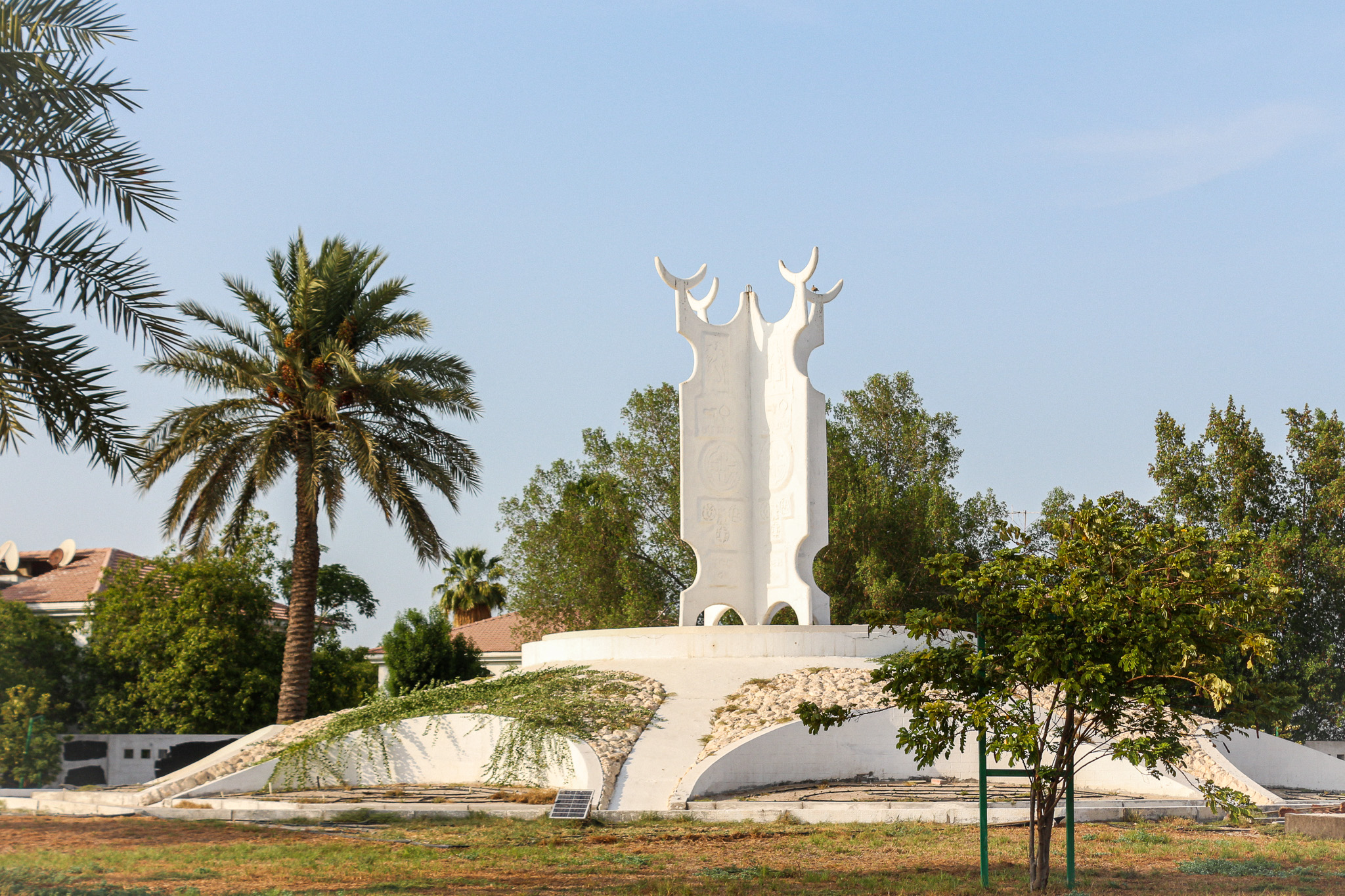
The picture below is of a postcard showing a view of Jidhafs Roundabout and the Dilmun monument that stands at its centre, located between Budaiya Road and Al-Sahla Road, locally known as Abdul Karim Roundabout. The postcard dates back to the early 1990s, capturing a landmark that has become part of Bahrain’s urban memory. The monumentwas constructed in 1986, designed by the Bahraini artist Rashed Al Arifi. Officially, the roundabout is named Jidhafs Roundabout, but it is popularly known as Abdul Karim Roundabout, after the late Colonel Abdulkarim Salman Jassim Al Mansoor, a former Bahraini police officer who owned a farm adjacent to the roundabout. (Aldurazi, 2018)
The monument originally featured four sculpted bull heads, symbolising the ancient Dilmun civilisation, positioned around its base as seen in the photo. However, these sculptures no longer exist today due to traffic accidents and vandalism over the years.
Other than that, there were two bull heads of Rashid AlOraifi built in Adhari Park, believed to be erected in 1977, and another one in Water Garden. (Unknown Source)
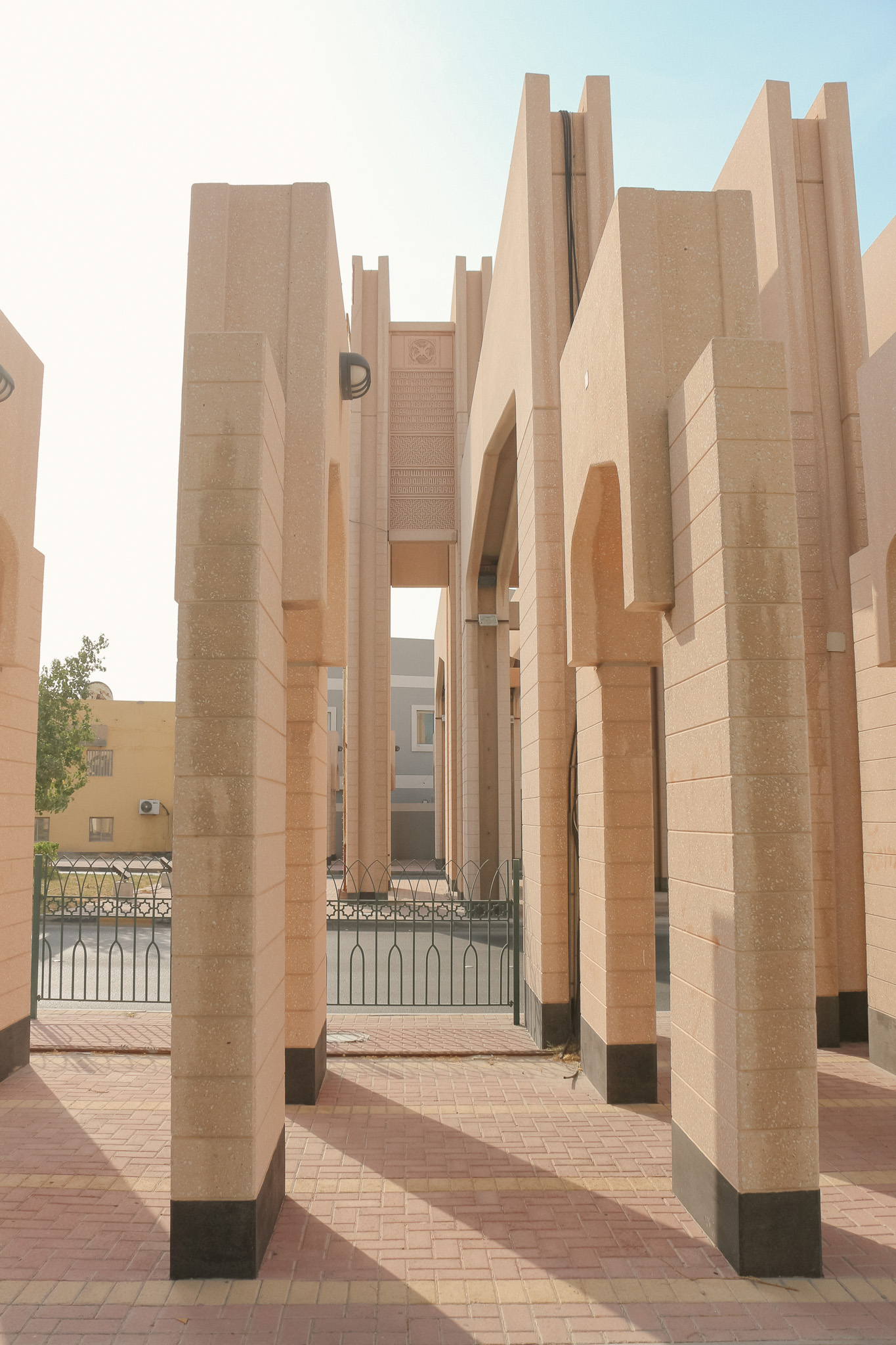
Besides his implacable architectural-level artworks, his Dilmun school extended to his brother Ahmed, who was commissioned by the Minister of Housing at the time of inaugurating Isa Town Gate (a story for next blog) to decorate its sides. The sides of the gate feature gypsum engravings, depicting Dilmun seals, traditional gypsum engraving patterns, and verses of the Quran (آية الكرسي), all contrasting with the very minimally ornamented gate.
References:
- Aldurazi, J. (n.d.) [Photograph]. Facebook. Available at: https://www.facebook.com/122067471726640/photos/a.140661146533939/270473233552729/?id=122067471726640

Sharing monthly edits of essays, photography and emails